Hello everybody, welcome to my recipe page, looking for the perfect Homemade Miso Using a Pressure Cooker recipe? look no further! We provide you only the best Homemade Miso Using a Pressure Cooker recipe here. We also have wide variety of recipes to try.
Before you jump to Homemade Miso Using a Pressure Cooker recipe, you may want to read this short interesting healthy tips about {The Simple Ways to Be Healthy. Becoming A Healthy Eater
Healthy self esteem occurs in the environment located at thefamily, school, peer group, work place, and neighborhood. There are certain features of your surroundings that have to be current in order for self esteem to be fostered and grow.
The main component of a healthy environment for self esteem is it needs to be nurturing. It should offer incomparable warmth, love, and caring. It needs to extend the realization that other people are known as deserving to be cultivated, reinforced, honored, and ensured to.
Healthy environment for self esteem absorbs messages of heat, loving, and caring by bodily signature, meeting the survival needs of food, clothing and shelter, and providing a sense of stability and order in life.
A healthy atmosphere for self esteem should provide approval. It will recognize that other people see each other as deserving individuals that possess a exceptional set of personality characteristics, skills, skills, and competencies which makes them unique. Acceptance enables people to create relationships with other people, nevertheless keep healthy boundaries of identity within themselves.
At the healthy environment for self esteem should be good communication, everyone ought to be heard and reacted to in a healthy way to ensure healthy problem solving can be possible. Appropriate giving and receiving feedback is both encouraged and rewarded.
That recognition and approval should not be based upon the condition that they must first conform to a prescribed standard of behavior or behavior. That is unhealthy. Unconditional recognition and acceptance contributed in the form of service allows people to attain their greatest potential.
The healthy atmosphere for self regard ought to be clearly defined and enforced limits known to individuals without the hidden tricks or manipulation. Limits enable people to recognize their duties and also to chart their course of behaviour in a reasonable way.
Respect and latitude for human actions within the defined limits of the healthy environment for self esteem ought to be present as well. This encourages people to use their imagination, ingenuity, and imagination to be productive within the recognized structure. Restrictions that suppress identity may lead to a slow focus, together with people getting stunted and handicapped in the use of their personal abilities, abilities, and tools.
Last, healthy atmosphere for self esteem should be bonding, that’s the physical/emotional phenomenon between people and the others in their own surroundings. This is essential for the development of healthy self esteem. Bonding is forming a mutual emotional attachment between an individual and a"significant other" (parent, child, friend, fan, etc.). This involves the substantial additional giving unconditional love and support as well as developing an emotional connection between each other.
We hope you got benefit from reading it, now let’s go back to homemade miso using a pressure cooker recipe. To make homemade miso using a pressure cooker you only need 3 ingredients and 22 steps. Here is how you achieve that.
The ingredients needed to prepare Homemade Miso Using a Pressure Cooker:
- You need 2 3/5 kg Fresh rice malt (nama koji)
- Take 1 3/5 kg Soy beans
- Get 800 grams Salt
Steps to make Homemade Miso Using a Pressure Cooker:
- Rinse the soy beans, and soak them in plenty of water overnight. They will swell up to twice their size by the next day.
- Put the soy beans into twice their volume of water in a pressure cooker and bring to a boil. Skim off the white scum that rises to the surface.
- Put the perforated metal plate that comes with the pressure cooker on top. Lock the lid on and cook under pressure for 10 minutes, then leave to cool down naturally. *If you have a small pressure cooker, cook the soy beans in 2 batches.
- This is the fresh rice koji I ordered by mail and used this time. There are 2 bags containing 1.3 kg each. You can use dried rice koji instead!
- While the soy beans are cooking, mix the koji and salt together.
- Drain the cooking liquid from the cooked soy beans, and hold onto it to use later. *If you're cooking the soy beans in several batches, just keep the cooking liquid from the final batch.
- Let the soy beans cool a bit, and put them in a plastic bag. They'll be hot so wrap the bag in a towel and press down with your hands to mash them. The beans are very soft so this should be easy.
- Add the combined koji and salt from Step 5 to the mashed soy beans and mix well. Mix in some of the cooking liquid until the paste is about the consistency of hamburger mixture or about as soft as your earlobe.
- Line a large container or tub with a double layer of plastic bags. Roll the paste into apple sized balls (these are called miso balls) and throw them hard into the container. Press them in firmly to eliminate any air pockets.
- When all the miso balls have been put into the container, press down hard on the whole mass again while putting your weight into it to remove any air. Sprinkle a handful of salt on top evenly. (This is to prevent the surface from developing mold.)
- Squeeze the inner plastic bag closed while pushing out any air inside. Press a small lid or plate on top, add a weight on top of that and wrap and close the outer plastic bag over all. Cover with a lid.
- Wrap the whole container with another plastic bag. Leave it in a dark, cool place out of the sun.
- Here's the schedule from this point on:
- Mixing up from the bottom (1st time): Check on the miso after about 2 months to see if it has developed any mold! If it has, just remove the parts with the mold. Mix the whole thing up from the bottom after removing the moldy parts.
- Mixing up from the bottom (2nd time): Open up the miso 4 months after the first time you mixed it up! Mix it up from the bottom again.
- If the miso has matured enough when you mix it up the 2nd time you can start eating it, but it will become more delicious if you let it mature for a while longer.
- I made miso this time on February 3rd, the day of spring (Setsubun no Hi). I'm looking forward to how it will turn out.
- April 30th: The first mixing up! It's about 3 months after I made the miso. I opened the lid slowly since I was afraid it had developed mold.
- Looks so good! It's fluffy, and actually starting to smell like miso! It hadn't molded at all as I'd feared, and it's turned into miso. It's not yet edible at this point, though.
- I mixed it up from the bottom. To do this I took the plastic bag out and squeezed the miso over the bag. This way my hands are not in direct contact with the miso, so no bacteria gets into it.
- I returned the plastic bag to the container, and levelled out the surface with a wooden spatula. I closed up the plastic bags again as described above. I left it in a cool, dark place. I'll check on it again in September…maybe it will be ready to eat by then…
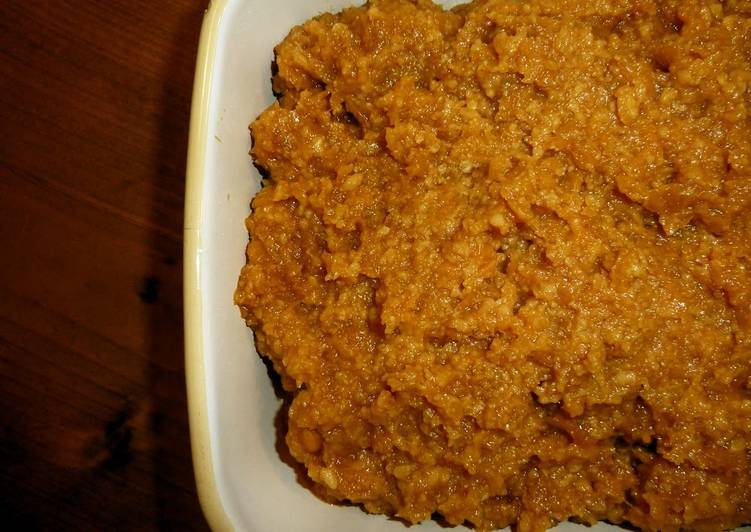
- End of August: It's matured into a delicious looking miso. It's ready to eat at this point. The top photo is of the miso at this stage.
Nowadays, you can even bake in your pressure cooker! Many people who are using electric pressure cookers like Instant Pot Pressure Cooker are even making cheesecakes and homemade yogurt. So really, the possibilities on how to use a pressure cooker are endless! In a large heatproof bowl, combine leek, onion, carrot, garlic, and ginger. A while ago, My hubby did a ramen cooking class with this miso ramen recipe.
If you find this Homemade Miso Using a Pressure Cooker recipe helpful please share it to your good friends or family, thank you and good luck.