Hey everyone, welcome to our recipe site, If you're looking for new recipes to try this weekend, look no further! We provide you only the perfect Ohagi Rice Cakes recipe here. We also have wide variety of recipes to try.
Before you jump to Ohagi Rice Cakes recipe, you may want to read this short interesting healthy tips about {The Basics of Being Healthy. Getting A Healthy Eater
Are you wanting to lose weight or simply enhance your health? Watching the foods which you consume and the fat and calories you consume is a excellent way to keep on a happy and healthy course.
As significant as eating healthy is always to losing weight and staying healthy, it can be tough to do. Eating healthy is most likely the hardest when dining out. Lunch menus tend to be stocked full of pictures that are appealing, but often lacking from these is the significant information, such complete carbs and fat. For the reason, you might find it difficult to make healthy decisions out of a lunch menu.
The first step in creating healthy choices from a lunch menu is choosing your location wisely. In case you’ve got several options, when seeking to flake out, it is vital that you give each alternative a quick examination. Though fast food establishments have started to integrate healthy foods and foods into their menus, so you might find it easier to eat healthy at a traditional family restaurant. The same may be said for all you can eat buffets, they are usually stocked full of convenient foods, not necessarily healthy foods.
You could also make healthy choices from a lunch menu by searching for a healthy eating section. As the foods which we eat are still a controversy surrounded by debate, most restaurants have started developing healthy eating divisions on their menus. These segments are usually full of low calorie foods and side dishes, in addition to those who are reduced in fats or saturated fats.
Using your very best judgment is just another one of many ways you can make healthy choices from a dinner menu. This is best accomplished by analyzing dinner pictures onto a single menu. It’s also advised that you avoid foods overrun with cheese, mayonnaise and even sour cream. If your selection includes these fattening condiments, make sure you ask for a reduced amount.
Speaking of requesting for a lesser amount, you are going to want to ask any questions which you have. Would you like to understand whether the restaurant includes low fat milk, sour cream, or sweet? You won’t need to assume they do; therefore, you might want to request your server. In fact, you could also wish to ask about carbs and fat. Many restaurants will have brochures hand outlining each dish that they function, including ingredients, calories, and fat. But this information is not always readily available to consumers.
Even if after taking the aforementioned approaches, you are not able to find satisfying healthy foods in your lunch menu, so you might choose to order a healthy side dish or drink. Water is a great choice, particularly when compared to soda. Salads make good side dishes, particularly the ones that are eaten with no salad dressing or low-fat salad dressing. Of course, you might want to take additional actions to ensure that you decide on a healthy mealbut if you choose to forgo low calories for taste, require extra steps to make certain you get some nutrition.
We hope you got benefit from reading it, now let’s go back to ohagi rice cakes recipe. To cook ohagi rice cakes you only need 5 ingredients and 10 steps. Here is how you cook it.
The ingredients needed to prepare Ohagi Rice Cakes:
- Provide 150 g sticky rice (mochi-gome)
- Provide 180 ml water
- Get some soy bean powder (kinako)
- Provide some sugar
- Provide some bean jam (if you use the canned, you might need to microwave it to dehydrate a little)
Instructions to make Ohagi Rice Cakes:
- Preparation of rice. Wash the rice and put in a colander to drain the water off for a while. Then put it in a bowl (of the rice cooker) with the 180 ml water. Leave it for more than 1 hour.
- Cook the rice. If you don't have a rice cooker, you can use a normal pot and an oven or a microwave. If you use a pot, put a lid and heat it until boiling. Then lower the heat and cook for about 15 minutes. Stop heating and leave it for 10 minutes with the lid on. In case of microwave, put in a microwavable bowl and cover with plastic wrap. Microwave for 5 minutes, then turn over the rice with a big spoon or spatula, and repeat it again. After the last 5-min microwave, leave the bowl in the oven (with the plastic wrap on) for 10 minutes.
- Mash the rice while it is hot. We don't mash it completely but halfway (which is called "half-killing" in Japanese).
- ("Half-killed" sticky rice)
- Prepare the bean jam and the kinako. Microwave the bean jam if it is too wet (be careful, it will be very hot and you may burn your hands. Cool it down). Mix the kinako powder with sugar in a bowl.
- Wet your hand (a bowl of water on your side is useful) and take some of the rice in your hand.
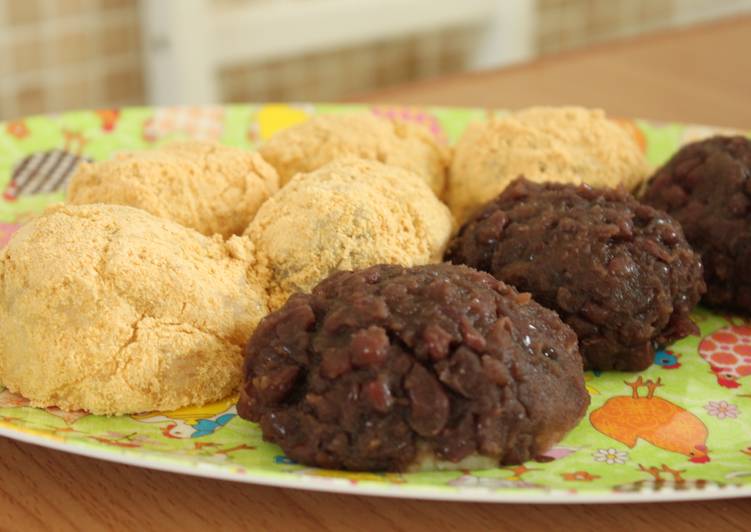
- For Kinako ohagis, spread the rice, put a ball of bean jam and wrap up. Put the rice ball in the bowl of kinako powder.
- For Anko (bean jam) ohagis, make a rice ball and wrap it with the bean jam.
- We must not keep ohagis in a fridge. So it's better eat them as soon as possible.
- I also tried kinako with matcha green tea powder.
In the West, ohagi are found at Japanese markets in the refrigerated section. Anko (sweet bean paste) This is the chocolate brown sweet bean filling that is encased in ohagi (glutinous rice cakes). This Asian rice cakes recipe came from Mama Lin's attempt to make Korean rice cakes, specifically the kind used in tteokbokki. Like in Korean cuisine, steamed rice cakes are prevalent in Chinese. Ohagi (Japanese Sweet Rice with Adzuki Paste).
If you find this Ohagi Rice Cakes recipe useful please share it to your good friends or family, thank you and good luck.