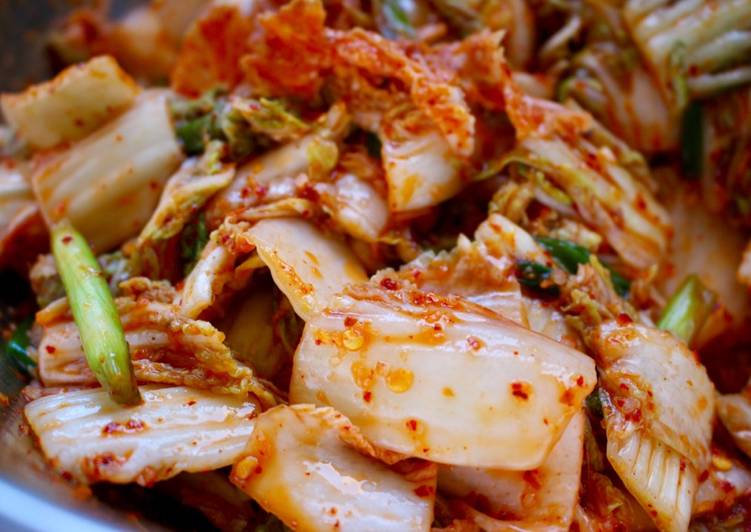
Hello everybody, welcome to our recipe site, If you're looking for new recipes to try this weekend, look no further! We provide you only the best Kimchi (Easier than you think! ;) ) recipe here. We also have wide variety of recipes to try.
Before you jump to Kimchi (Easier than you think! ;) ) recipe, you may want to read this short interesting healthy tips about {The Basics of Being Healthy. Becoming A Healthy Eater
Healthy self esteem occurs from the environment found in thefamily, school, peer group, work place, and neighborhood. There are certain characteristics of your surroundings which have to be present in order for self respect must be fostered and develop.
The principal part of a healthy atmosphere for self respect is that it should be nurturing. It has to provide the understanding that other people are known as deserving to be nurtured, reinforced, honored, and ensured to.
Healthy environment for self esteem conveys messages of heat, loving, and affectionate by physical touch, meeting the survival needs of food, clothing and shelter, and providing a sense of stability and order in life.
A healthy atmosphere for self esteem should provide acceptance. It will recognize the other people see each other as deserving individuals that have a special set of personality characteristics, skills, abilities, and competencies which makes them special. Acceptance empowers people to develop relationships with other people, nevertheless maintain healthy boundaries of identity within themselves.
At the healthy environment for self esteem should be good communicating, everyone should be heard and responded to in a healthy manner so that healthy problem solving is possible. Suitable giving and receiving feedback will be encouraged and rewarded.
That recognition and acceptance shouldn’t be based upon the condition they must first conform to a prescribed standard of behaviour or behavior. That is unhealthy. Unconditional recognition and approval contributed in the form of support permits individuals to achieve their ultimate potential.
The healthy environment for self respect ought to be clearly identified and enforced limits known to individuals with no hidden tricks or manipulation. Limits set the structure for the lives of individuals, allowing clear benchmarks of appropriate and inappropriate behavior. Limits enable people to recognize their duties and to chart their course of behavior in a rational way.
Respect and latitude for individual actions within the specified limits of the healthy atmosphere for self regard ought to be present too. This encourages individuals to utilize their imagination, creativity, and creativity to be productive within the established structure. Limits that suppress identity may cause a narrow focus, with people getting stunted and handicapped in the usage of their own skills, skills, and tools.
Last, healthy environment for self esteem ought to be bonding, that’s the physical/emotional phenomenon between people and others in their surroundings. This is necessary for the growth of healthy self esteem. Bonding is forming a reciprocal psychological attachment between an individual and a"significant other" (parent, child, friend, lover, etc.). This includes the significant other giving unconditional love and support as well as developing an emotional connection between every other.
We hope you got insight from reading it, now let’s go back to kimchi (easier than you think! ;) ) recipe. To cook kimchi (easier than you think! ;) ) you need 11 ingredients and 9 steps. Here is how you cook it.
The ingredients needed to cook Kimchi (Easier than you think! ;) ):
- Get 4-5 pounds Napa cabbage, cut into roughly 1"x 2" pieces (about 30 cups of chopped raw cabbage)
- Use 1 bunch green onions, washed, roots trimmed, and cut into 2 inch segments
- Take 5 Tablespoons kosher salt (about 10% less if you're using regular table salt)
- You need For the paste:
- Get 1/4 cup minced garlic (about 5 or 6 large cloves)
- Get 1/4 cup minced fresh ginger root (about a 2" segment, peeled)
- Take 1/4-1/2 cup crushed red chili flakes depending on how hot you want your kimchi. See notes above re: gochugaru
- You need 1/4 cup steamed white rice, lightly packed. Short or long grain is fine. If stale, microwave with 2 Tbsp. water for 1 minute
- You need 1/4 cup fish sauce
- Prepare 1/4 cup sugar
- Provide 1/4 cup water for blending + 1/3 cup water for rinsing seasoning from bowl (see directions below)
Steps to make Kimchi (Easier than you think! ;) ):
- In a large stainless steel or mixing bowl, toss the raw cabbage, green onion, and the salt together to pre-brine the cabbage. Make sure to thoroughly incorporate the salt throughout the cabbage. In 10 to 15 minutes, you should start to see the cabbage leach liquid and wilt. Let the cabbage sit for 1.5 to 2 hours, tossing and redistributing every 30 minutes to ensure even brining.
- After at least 90 minutes of pre-brining, rinse the cabbage with enough water to cover the cabbage by 4 or 5 inches by swishing the cabbage in the water 7 or 8 times. Remove the cabbage into a strainer and let the excess water drain while you prepare the paste.
- Make the paste by putting all the paste ingredients into a blender and blend until you can't see the individual grains of rice. Pour the paste over the cabbage.
- Get into the bowl with your hands and mix the paste into the cabbage until all the pieces are evenly and thoroughly coated.
- Pack your kimchi into a clean, dry bottle or other tight-lidded container (this time I repurposed a half gallon kimchi jar) and use the last 1/3 cup of water to swish around the mixing bowl, pick up all the remaining paste, and pour that liquid on top of your kimchi. Remember to leave 2 to 3 inches of headspace at the top to allow for expansion as fermentation takes place.
- Your batch of kimchi is now ready for fermentation in a dark but not cold place like the inside of your cupboard. Or, if you can find a warmish spot in your garage, you can put it there. (I know that's not always possible for cold climate people in the middle of winter.) As it ripens, it's a good idea keep the lid slightly unscrewed to relieve the pressurization caused by fermentation. (Your jar can literally explode from the pressure on a specially active fermentation day.)
- People often ask HOW RIPE DOES THE KIMCHI HAVE TO BE BEFORE I REFRIGERATE OR EAT IT? You can eat the kimchi whenever you want. Fresh, just after it's been made, all the way up to when it's so incredibly old, ripe and stinky you could choke out a subway system by placing an open jar in one of the vents. It remains safe for human consumption for A VERY LONG TIME.
- But as to when to refrigerate, just go out once a day every day to taste a piece, and when it gets to the ripeness you like, stick it in the fridge. It'll continue to ripen, but very slowly.
- Enjoy! :)
It is easier than you think! When you use easierthanyouthink.ca, you can connect to your course and specific lesson and review and practice at your own pace. You can watch video lessons, review past exams or practice on randomly generated problems based on the curriculum. Bacteria and other microbes (including fungi and viruses) are often thought of as sources of disease Fermented foods include sauerkraut, kimchi, miso, kombucha and many pickles. Many people claim they find sourdough easier to digest than other bread, but it is likely that the lengthy.
If you find this Kimchi (Easier than you think! ;) ) recipe useful please share it to your good friends or family, thank you and good luck.