Hello everybody, welcome to our recipe page, if you're looking for Ohagi (Bota Mochi) recipe, look no further! We provide you only the perfect Ohagi (Bota Mochi) recipe here. We also have wide variety of recipes to try.
Before you jump to Ohagi (Bota Mochi) recipe, you may want to read this short interesting healthy tips about {Easy Ways to Get Healthy. Becoming A Healthy Eater
Healthy self esteem originates in the environment located in the: family, school, peer group, work place, and community. There are certain characteristics of your surroundings that have to be present in order for self esteem must be sabotaged and develop.
The major component of a healthy environment for self respect is the fact that it should be nurturing. It should provide unconditional warmth, love, and caring. It ought to offer the realization that other people are recognized as worthy to be cultivated, reinforced, honored, and ensured to.
Healthy atmosphere for self esteem transmits messages of heat, loving, and caring by physical touch, meeting the survival needs of food, clothing and shelter, and offering a feeling of equilibrium and order in everyday life.
A healthy atmosphere for self esteem ought to offer acceptance. It will realize that other people see each other as deserving individuals that possess a special set of personality traits, skills, abilities, and competencies which makes them special. Acceptance enables people to create relationships with others, yet maintain healthy boundaries of identity inside themselves.
At the healthy environment for self esteem ought to be good communication, everybody should be heard and responded to in a healthy way to ensure healthy problem solving can be possible. Appropriate giving and receiving feedback will be both encouraged and rewarded.
That comprehension and approval should not be based on the condition they must conform to a prescribed standard of behaviour or behavior. This can be unhealthy. Unconditional recognition and approval provided in the form of support permits individuals to attain their ultimate potential.
The healthy environment for self regard ought to be clearly identified and enforced limits known to individuals with no hidden tricks or manipulation. Limits set the arrangement for the lives of individuals, allowing clear benchmarks of appropriate and inappropriate behavior. Limits allow individuals to recognize their duties and also to chart their course of behavior in a reasonable way.
Respect and latitude for individual action within the defined limits of this healthy atmosphere for self esteem ought to be present also. This encourages people to use their imagination, ingenuity, and imagination to become productive within the established structure. Restrictions that suppress individuality may lead to a narrow focus, together with people becoming stunted and handicapped in the use of the own skills, skills, and tools.
Last, healthy atmosphere for self esteem ought to be bonding, that’s the physical/emotional occurrence between people and the others in their environment. This is essential for the growth of healthy self esteem. This involves the significant additional giving unconditional love and assistance as well as developing a psychological connection between every other.
We hope you got insight from reading it, now let’s go back to ohagi (bota mochi) recipe. To cook ohagi (bota mochi) you only need 5 ingredients and 7 steps. Here is how you achieve that.
The ingredients needed to prepare Ohagi (Bota Mochi):
- Get 2 cups (*180ml cup) Glutenous Short Grain Rice
- Prepare *Note: You can replace 1/2 cup (90ml) of it with regular Short Grain Rice
- Prepare 1 pinch Salt
- Get Sweet Azuki Paste *Tsubu-an OR Koshi-an
- Use Kinako (finely ground Roasted Soy Beans) & Sugar *See ‘Method 5’
Steps to make Ohagi (Bota Mochi):
- Wash Rice and place it in the rice cooker. Add water up to the 2-cups-marking. Allow to soak for 30 minutes if you have time.
- Add 1 pinch Salt and press ‘COOK’ button to start cooking.
- Transfer to a bowl. Using a pestle or something similar, pound the hot rice, wetting the pestle with Water frequently. Stop pounding when the texture is rubbery like Mochi yet you still see grains.
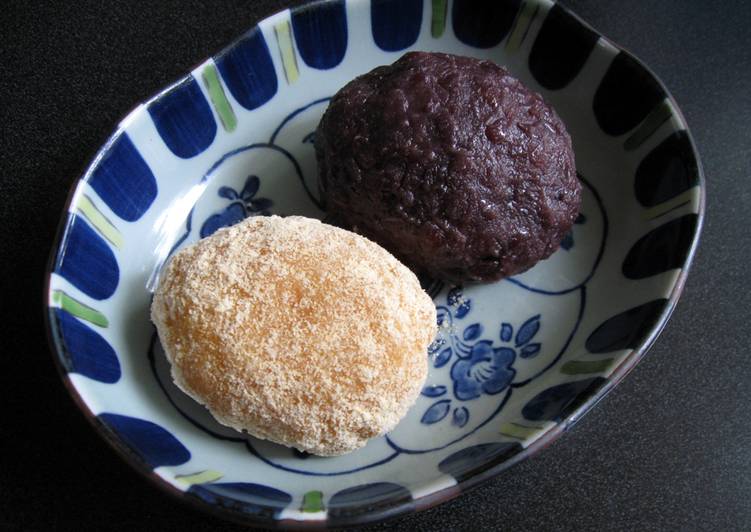
- Wet your hands with Water and make 3 x 4cm (or larger) balls, and cover with Sweet Azuki Paste or Kinako Sugar.
- How to make Kinako Sugar: Kinako is finely ground Roasted Soy Beans. Mix a same amount of Kinako and Caster Sugar with 1 pinch Salt.
- Easy method to cover with Azuki Paste: Spread Azuki Paste thinly on a sheet of plastic food wrap, about twice the size of the rice ball. Place the rice ball and wrap it and cover the rice ball with Azuki Paste evenly.
- *Note: Naturally you can do this process without the plastic wrap. Thinly spread Azuki Paste on your palm, place rice ball on it, then cover it around.
My understanding is bota-mochi is named from botan (name of spring flower/ paeonia), and ohagi is from Rhubarb is correct. Bota mochi is like a daifuku turned inside out, where the mochi ball is on the inside and the filling, such as red bean paste, is coated on the outside. Botamochi (牡丹餅?) ou ohagi (御萩?) são bolinhas de arroz, similares ao mochi, cobertas de feijão doce ou gergelim. O nome, ohagi, vem de uma flor típica do outono, hagi (uma espécie de Magnólia) e o nome, botamochi. Discover the magic of the internet at Imgur, a community powered entertainment destination.
If you find this Ohagi (Bota Mochi) recipe useful please share it to your friends or family, thank you and good luck.